Fixing Bit Evasions

The most common reason for a horse to evade the bit is that the rider has unsteady hands. The rider’s hands may be seesawing or pulling or constantly bumping the horse’s mouth and the horse looks for a way to get away from the annoyance. The bit may be too thick or too wide for that horse’s mouth or the horse may have a dental problem. The bit may fit the horse well but be the wrong bit in a particular rider’s hands. Horses that have been ridden in draw reins often go behind the bit when the draw reins are taken off.
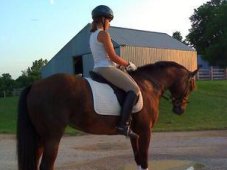
Evasions take various forms. Some horses tend to go above the bit. They raise their heads high, tense their neck, tighten their back, and tense their hindquarters, often because their conformation predisposes them that way in the first place. The result is that they cannot step off correctly with their hind feet. Horses commonly evade the bit by going above it when the rider’s hands are unsteady or when there is not enough forward motion. The rider may be tentative and doesn’t allow the horse’s forward motion, the rider may not know how to use driving aids properly to send the horse forward, or the rider may not have the strength and coordination to ask the horse to move forward freely.
Other horses go behind the bit by curling their neck and putting their noses to their chests to avoid the hand and bit. This is a harder evasion to correct than going above the bit. Horses commonly go behind the bit when, again, the rider’s hands are unsteady. Bits that are too large, do not fit properly, and draw reins are other contributors to the problem. If a horse is worked in a leverage bit with a chain under his chin, he is more likely to try to evade by going behind rather than above it.
The problem with both of these evasions is that they quickly become habits. A trainer with good hands may help the horse learn how to quietly accept contact with the bit again. However, when a habit becomes deeply ingrained, the horse will want to fall back into it whenever someone with just average riding skills makes him the least bit uncomfortable again.
When unsteady hands are the root of the problem, the rider needs to work on an independent seat. That means the rider can ride in balance with quiet hands. The rider should never use the reins for support or balance and the hands have to be able to work independently of the rider’s seat. Only then can the rider apply the aids independently and correctly.
To achieve an independent seat, the rider has to work his or her way up the riding tree starting with relaxation, then balance, following the horse’s motion, applying the aids and coordinating the aids. With an independent seat, the rider can finally influence the horse.
To understand how unsteady hands feel to the horse, pair up with a buddy and play the ?bit game.? One person holds the bit while the other holds the rein and applies pulls, bumps and other motions. Simulate the motions you typically use when asking your horse for turns, half halts, and halts and you’ll have a greater appreciation of your horse’s viewpoint.
If a horse has developed a bit evasion because of its rider’s unsteady hands, that rider’s first goal should be to work on getting her hands independent of her seat. For example, if she can follow the motion of the canter with her seat, her hands should not be following the motion, too. A simple test for this is to see if she can drop her pinkie onto the horse’s neck and keep it there. If she can’t, her hands are bouncing. Another test is to hold the whip horizontally from hand to hand and hold it against the horse’s neck to see if one hand is moving more than the other. Working without reins on a longe line is a time-honored way to help a rider develop an independent seat.
Once the rider has an independent seat and her unsteady hands are no longer the issue, she can begin to work on undoing her horse’s evasive habit. She can longe her horse in side reins or work him in a round pen with side reins. The steady, elastic contact of side reins helps the horse understand that reaching for the bit can be comfortable after all.
Putting the horse on the predictable pattern of a circle can help set a good rhythm and encourage the horse to relax. It is critical to get the horse to relax in order to correct the evasion. Like longing, the horse working on a circle understands where he is supposed to be and he will start to experiment with reaching for the bit.
Another excellent way to encourage rhythm and relaxation is to work the horse over low cavelletti or ground poles. These also encourage the horse to stretch forward and down. When he does this and finds that he can now trust his riders hands to be steady and soft, the horse will begin reaching for the bit.
Although it is not an evasion of the bit, some horses learn to lean on their riders hands for balance. Half halts and transitions can help these horses bring their hind legs farther under their bellies and carry more of their weight on their hindquarters. As the horse steps under himself more, he becomes better balanced and can soften in front.
If your horse evades the bit, one of the first things you should do is have his teeth checked by an equine dentist to make sure there is nothing causing him physical discomfort. Then make sure that the bit is the right size and is fitted correctly. The bit should not be too thick or too thin. It should not stick out either side of the horse’s mouth nor should it pinch the lips. If the bit hangs too low or too high in the horse’s mouth, it can bump the teeth and make the horse uncomfortable. With a snaffle, there should be one or two wrinkles in the lips so that the bit is seated firmly in place. A dropped, figure eight or flash noseband can help hold a snaffle in place so it cannot slip sideways through the horse’s mouth if the rider takes too much rein on one side or the other. Make sure the throatlatch is not so tight that it restricts the horse’s breathing and that all of the bridle straps lay flat, not twisted.
If the horse is always comfortable with his bit, the bridle, and his rider’s hands, bit evasions will not get started in the first place.