Grooming Your Cat

It is important that you get your cat accustomed to bathing and grooming early in life by starting off with small, fun sessions when your cat is still young. You must also choose a method which will be fun for you and carry it out only when you have plenty of time. If you are stressed or rushed when bathing or grooming your cat, your cat is not likely to enjoy the experience.

Read more
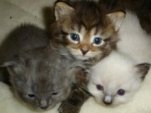
Hand-Rearing Kittens: Hypothermia

This is a frequent cause of neonatal death. Kittens have no control of their body temperature at first. Their small size means they quickly lose heat. Their inability to store glucose for long means they run out of metabolic fuel which would generate internal heat (hypoglycaemia). Hypothermic kittens feel cold and limp. Their blood pressure drops, their circulation slows and their paws, abdomen, tongue and gums become pale (then bluish) due to reduced oxygen supply. The vital organs and digestive system cannot function at low temperatures or with reduced circulation. The kitten will become comatose if not treated promptly.

Read more

Hand-Rearing Kittens: Hypoglycemia (Low Blood Sugar)

Caused by inadequate or infrequent feeding; also when abandoned kittens are found and have not been able to nurse for some time (e.g. mother killed or driven away). Kittens up to two weeks old can store very little glucose in their bodies. Small kittens are also at risk. Kittens with a septic infection need glucose in order to fight the infection; they will need feeding every 2 hours day and night. In general, feeding every 2 hours prevents hypoglycaemia.

Read more

Hand-Rearing Kittens: Hypoxia (Oxygen Starvation)

Oxygen starvation can result from a prolonged or difficult birth. It is often the result of placental failure or umbilical cord obstruction during the birth or respiratory obstruction. Affected kittens are usually less active than their litter mates. The suck reflex may be weak or missing altogether. They are often too weak to survive unaided so it is essential to identify affected kittens quickly after birth and to start treatment promptly. In some cases there will be brain damage; mildly damaged kittens may go on to lead relatively normal lives. Severely affected kittens should be euthanized.

Read more

Vaccinations for Cats

Both adult cats and kittens need to be vaccinated, and conscientious annual vaccinating is the only way to protect your pets from sometimes distressing illnesses. Indeed, there might not be a cure for every virus that your cat might contract, so prevention is the only responsible measure to take.

Read more

Disabled Cats: Caring for a Blind Cat

Cats that keep bumping into things either can’t co-ordinate their limbs or can’t see. A blind eye is often cloudy or the pupil remains dilated even in bright light. Some cats are born without eyes (anopthalmia) or with very small eyes (micropthalmia) which may not function. Others lose their sight either permanently or temporarily as a result of illness, physical injury, brain damage or poisoning (including extreme reaction to anesthesia) and conditions such as glaucoma, cataracts or scarring caused by untreated entropion (in turned eyelashes).

Read more

Disabled Cats: Caring for a Deaf Cat

Some cats, e.g. some blue-eyed whites, are born deaf. Many other cats are thought to be ‘grumpy’ by owners who don’t realize that their cat can’t hear. Deafness can be congenital or related to age, illness or physical injury. Many cats lose their hearing gradually as they age (as do many humans), sudden loss of hearing is normally the result of illness or injury and may be temporary or permanent.

Read more

Hand-Rearing Kittens

Information presented here has been provided by human foster mothers, veterinary staff and cat shelter workers. Many hand-rearing articles are aimed at breeders or contain veterinary terms. My own experience is related to cat rescue/shelter work where I have helped in supplementary feeding or emergency care of kittens.

Read more

Can Cats Talk?

Can cats talk? Many cat owners would like to think so and some even claim that their cats speak a number of recognizable words. A Brazilian cat takes claims one step further by apparently being able to sing a number of well known songs while the Fortean Times carried a report of a cat which speaks several words in Turkish and suggested, with tongue firmly in cheek, that the reason many owners cannot understand their cats is because the cats are speaking Turkish. But before cat-owners rush out for phrase books, are these cats really speaking or are their owners just talking turkey?

Read more

Is Cat Coat Color Linked to Temperament?

At the cat shelter where I work we refer to "naughty torties" and "laid back blacks". One of our vets also used the "naughty tortie" epithet and told us it is "well known that tortie cats are temperamental". However, the addition of white has a "calming effect" and tortie-and-whites are "not quite as temperamental as brindled torties. The naughty tortie tag is not applied to dilute torties (blue-creams), possibly because they are less common in the moggy population. Ginger cats are said to be spirited and fiery (and sometimes mean-spirited or sly) – very apt considering their fiery color and there is the epithet "ginger tom" to describe the supposedly typical alley cat. Blotched tabbies are "real homebodies" while their striped cousins are "more independent".

Read more

Cat Massage – A Hands-On Experience

One week in spring, during a routine massage session, I discovered a small hard lump on Sappho’s belly close to a nipple. Since Sappho got a weekly massage (and a general belly rub daily if she could persuade me), I knew that the lump was had developed since her previous massage. Using my fingertips, I could feel that the lump was a hard nodule beneath the skin and was not associated with a flea-bite.

Read more

The Pros and Cons of Inbreeding in Cats

Inbreeding is the mating together of closely related cats, for example mother/son, father/daughter, sibling/sibling matings and half-sibling/half-sibling. It is the pairing of animals which are more closely related than the average population. For breeders, it is a useful way of fixing traits in a breed – the pedigrees of some exhibition cats show that many of their forebears are closely related.

Read more
deneme bonusu