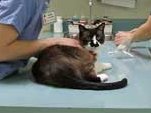
Advances in Feline Dental Care

As if suffering through a toothache without being able to do anything about it wasn’t bad enough, cats are also uniquely susceptible to what’s known as feline odontoclastic resorptive lesions, or FORLS, a very painful type of gum lesion. However, proper dental care can ensure that your cat doesn’t have to suffer through dental diseases like FORLs. And it has not only become a lot easier, but also more effective thanks to advances in both preventive care and treatment.
"All cats should be taken to the vet at least once a year to have their teeth professionally checked," says Dan Carmichael, DVM, Dipl. American Veterinary Dental College, and the editor of Recent Advances in Small Animal Dentistry. "Many dental problems are not detectable until the cats are under anesthesia having a good, complete examination."
Many cat owners fear that putting their cat under anesthesia may be more dangerous to their cat’s health than letting dental problems go untreated. However, according to Carmichael, the introduction of sevofluorane, used in human pediatric care, as a feline anesthetic has vastly improved safety. "The use of modern anesthesia techniques has reduced the risk of anesthetic in cats, [making it] 99.9 percent safe," he says. "On the other hand, the chances of making the cat feel better, improving their quality of life, is about 100 percent." Carmichael recommends making sure your veterinarian has put these new techniques into practice.
Another innovation in feline dental care is the use of dental X-ray machines – yes, sort of like the one that you see in your own dentist’s office, except it’s made specially for veterinarians. "Now you can look underneath the gumline," says Jan E. Bellows, DVM, Dipl. AVDC, and author of The Practice of Veterinary Dentistry. "Cats are notorious for having diseases hide underneath the gumline."
Dental diets are also a relatively new phenomenon, with various brands offering kibble that either chemically removes plaque, or provides a mechanical scouring action with "layers" of fiber. Ideally, cat owners should also brush their cat’s teeth daily, but as Carmichael reluctantly admits, less than 5 percent of "even my best cream-of-the-crop cat owners" find it possible to get past those fangs they’re supposed to be cleaning. "Cats just don’t see the humor in [having] their teeth brushed," he says. Carmichael’s tips for toothbrushing including starting during kittenhood, using a pet toothpaste, and loading up on the praise and loving, while Bellows recommends using a Q-tip dipped in tuna juice. "They seem to like that," he says. If only we could explain to our cats that toothbrushing now will save them a lot of pain later.